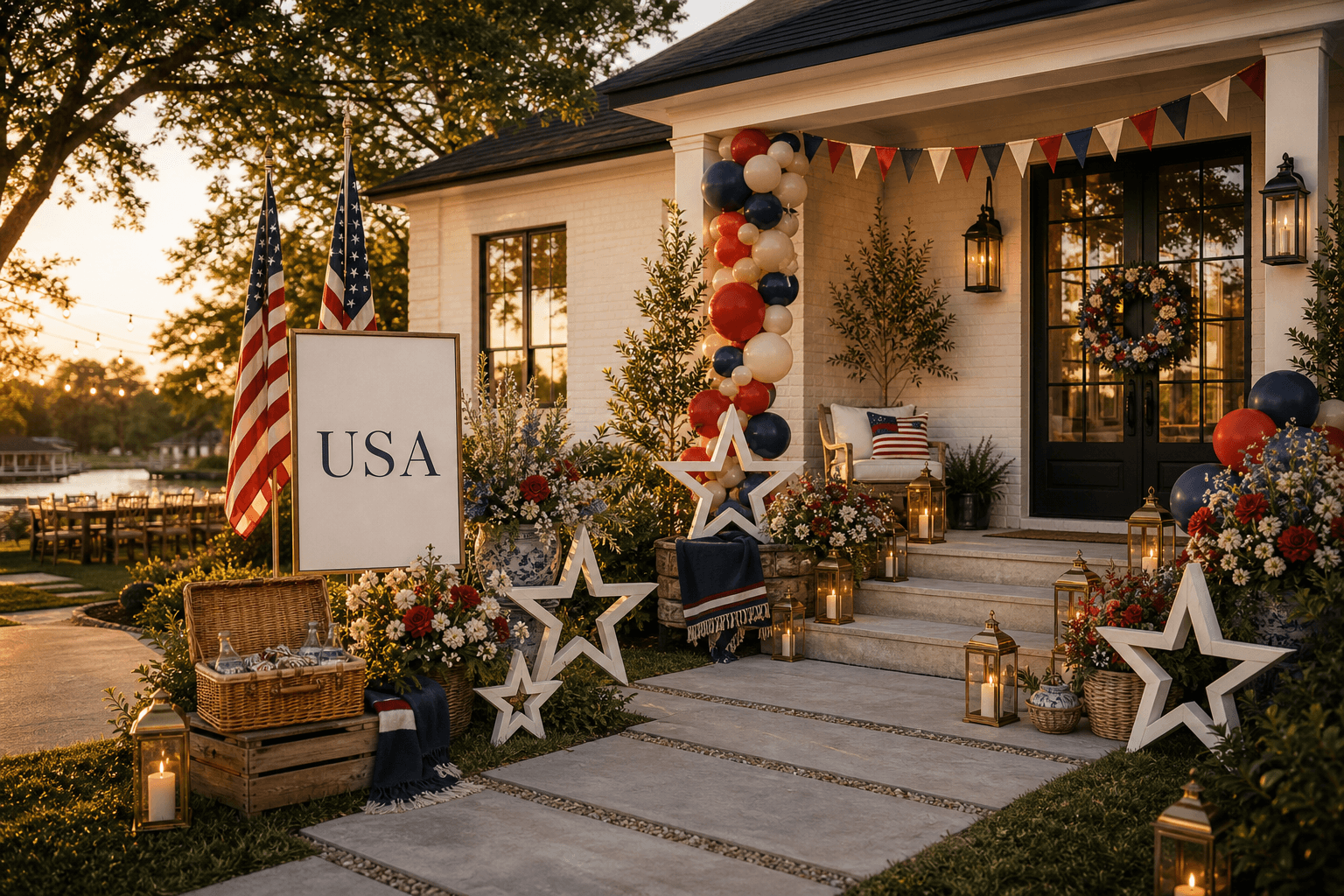
Fourth of July Front Yards That Go Beyond the Flag
A single flag is a statement of loyalty. A front yard display is a statement of intention, and most homes never make one.
The Fourth of July is the one holiday where almost every house on the block participates. That ubiquity is exactly the problem. Flags appear. Red-white-and-blue pinwheels get staked into mulch. A plastic Uncle Sam ends up near the mailbox. And by the time the neighborhood fills in, everything blurs together into visual noise that reads as "holiday" without reading as anything else. The homes that stand out are the ones that approached it differently, not with more decoration, but with more deliberate decoration.
Patriotic Decor Has Two Failure Modes
The first is undercommitment: a single flag, maybe a wreath on the door, and nothing else. It signals awareness of the holiday without actually celebrating it. The second is the opposite, every patriotic item available from a big-box store, deployed simultaneously. Flamingos with top hats. Blinking LED rope lights in three colors. Foam stars staked at random intervals across the lawn.
Both fail for the same underlying reason: absence of a visual hierarchy. The eye has nowhere to land, no focal point to anchor the display, nothing that says "this was composed." Great outdoor decor, for any holiday, starts with a clear center of gravity and builds outward from there.
Red, White, and Blue Concentrated, Not Scattered
The palette is non-negotiable. But how you distribute it across your facade is a choice, and concentration almost always beats scattering.
Think about a painting with a strong focal point versus one where the same color appears in seventeen places across the canvas. The concentrated version reads as intentional. The scattered version reads as restless. The same principle applies to a front yard. If you're working with ribbon, florals, or lanterns, group the red-white-and-blue together in two or three anchor points rather than distributing it evenly. Your eye should land, rest, and appreciate, not search.
For a traditional two-story brick home in Southlake or Flower Mound, that might mean flanking the front door with two substantial arrangements and letting the rest of the facade breathe. The flag flies, but it's part of a composed scene rather than the only thing happening.
The Structural Elements That Actually Work
Flags and pinwheels are surface decoration. What builds a display that photographs well and reads from the street are structural elements with volume and presence.
Star clusters in varying sizes create depth and a sense of craft. Oversized bows and ribbon treatments, the kind used for grand openings and estate entries, read as elevated in a way that foam shapes simply don't. Lanterns in navy or aged brass add architectural weight. And greenery, used as a neutral base, gives the red and white something to pop against rather than competing with the facade.
This is especially relevant in DFW, where many homes feature wide brick facades, prominent garages, and significant distance between the front door and the street. At that scale, small decorations simply disappear. You need items with enough presence to register from 40 feet away, which usually means going larger than feels comfortable up close.
Block Party Energy vs. Estate-Level Patriotic
There's nothing wrong with block-party energy. Bright, loud, festive, it works for that context. But if your home has curb presence year-round, the Fourth of July is an opportunity to maintain that standard while fully committing to the holiday.
The difference usually comes down to material quality and restraint. One well-proportioned star cluster on a column says more than six small ones scattered across the porch. Ribbon that's wired, full, and properly tied reads completely differently than the thin craft-store variety. Florals with white blooms and deep greenery against navy backdrop elements feel elevated where plastic patriotic accessories feel disposable.
The goal isn't to suppress the holiday spirit, it's to express it with the same care you'd bring to any other design decision about your home's exterior.
What to Skip
Blinking LED light strings in red, white, and blue almost always cheapen a display, the animation draws attention to itself rather than to the composition. Plastic lawn inflatables, novelty yard signs with cartoon graphics, and anything that looks like it was designed for a gas station promotion all work against the elevated look you're after.
The test is simple: would this element look at home in a designer's front yard, or does it belong at a neighborhood parade? Both are valid settings. They're just different settings.
The North Texas Scale Problem
Dallas-Fort Worth homes present a specific decorating challenge that doesn't come up in older, denser cities. The lots are wide. The garages are prominent. The setbacks are deep. What works for a Cape Cod in New England, a simple wreath, a window box, a flag, looks lost on a 3,500-square-foot brick home in Argyle or Keller.
Scaling up isn't about adding more items. It's about choosing items with the right proportions for the facade they're dressing. Tall arrangements, wider ribbon treatments, clusters instead of singles, these are the adjustments that make a display feel designed for the home it's on rather than borrowed from a smaller context.
Done right, a Fourth of July front yard in DFW can be genuinely striking. The holiday gives you strong colors, clear symbolism, and a neighborhood full of context. The opportunity is to be the house that made it look intentional.
If you'd rather have someone else handle the setup, we do this for homes across the Metroplex.